There’s a scientific reason you see your cat obsessed with feathers: their fluttering motion mimics bird prey and triggers your cat’s hunting instincts, sharpening stalking and pouncing skills; however, you must be aware of the risk of choking or ingesting feathers and supervise play, offering sturdy, non-toxic toys to reduce hazards; when managed safely, feather play provides mental stimulation, exercise, and stronger bonds between you and your cat.
The Natural Instincts of Cats
Your cat’s behavior traces to the African wildcat roughly 9,000-10,000 years ago, so it retains an ambush predator’s toolkit: motion-tuned vision, sensitive whiskers, and a spine built for explosive leaps and short sprints up to 30 mph. You will notice stalking and sudden pounces even when well-fed; those sharp claws and teeth remain functional for capture and for practicing hunting skills during play.
Hunting Behavior
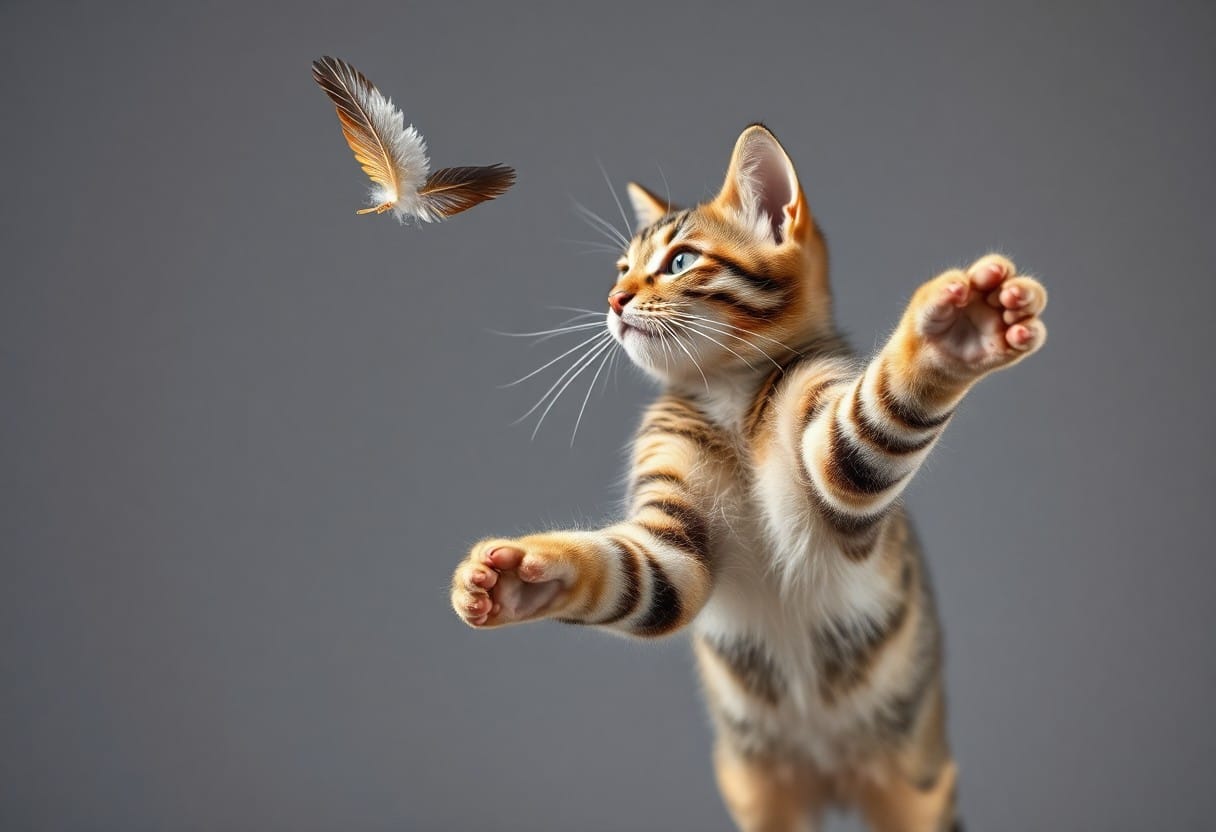
You observe a characteristic freeze, stalk, and pounce sequence that maximizes close-range success: silent paw placement, calculated tail adjustments, then an explosive launch. Fast-twitch muscles supply acceleration, while whiskers gauge distance; play reproduces these motor patterns, offering necessary exercise and coordination training, and letting your cat employ its bite-and-claw toolkit safely under supervision.
Prey Simulation
Feathers mimic winged prey by combining light weight, fluttering motion, and unpredictable trajectories that directly activate your cat’s motion detectors and pursuit reflexes. Sudden speed changes and short flutters often trigger aerial pounces and rapid chases. Choose synthetic or tightly bound feathers, since loose real feathers can carry parasites or pose a choking hazard, while well-made feather toys deliver high mental and physical stimulation.
You’ll get the best engagement with short, focused play: 5-10 minute sessions, 2-3 times daily, using bursts, erratic drifts, then a pause to invite stalking. Rotate toys every few days to prevent boredom, inspect for loose parts, and discard any with detached feathers to avoid ingestion. Vary height and hiding spots to increase difficulty and boost your cat’s predatory satisfaction and overall wellbeing.
The Role of Texture and Movement
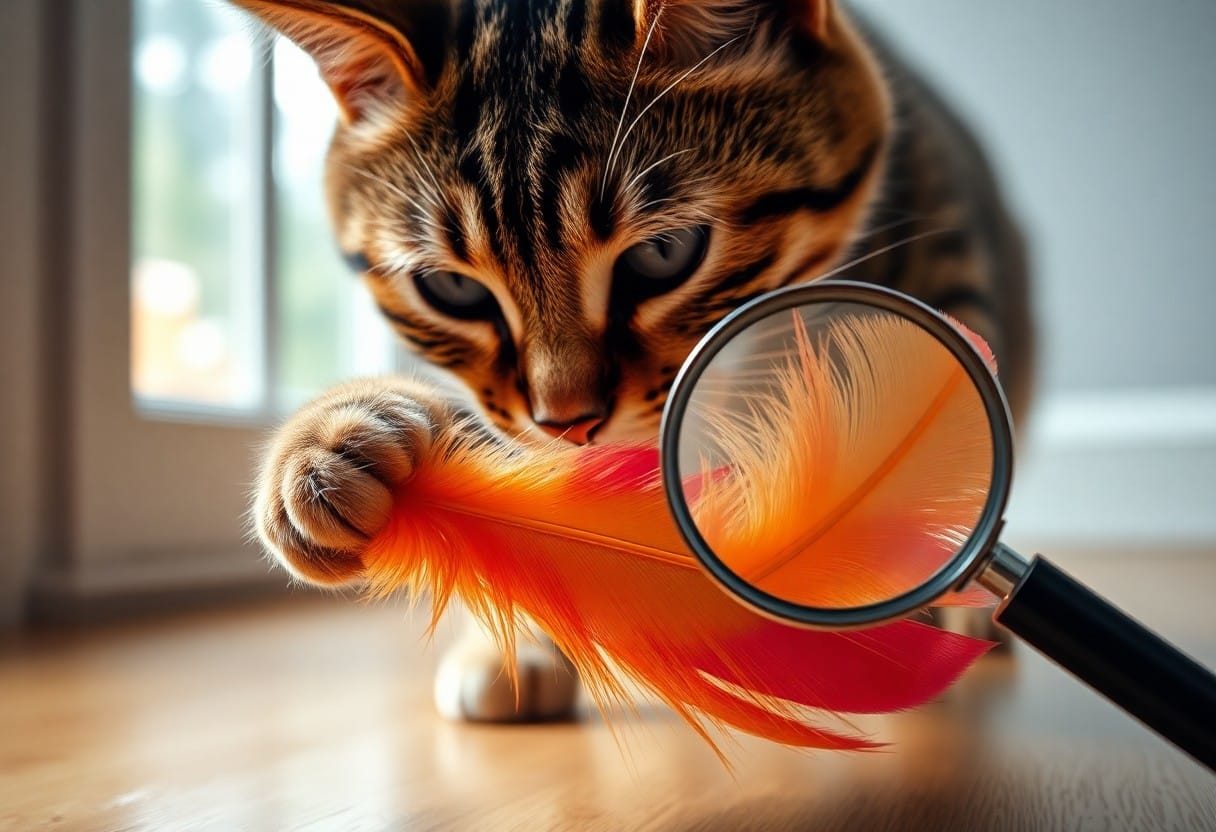
Feathers combine a soft, irregular texture with unpredictable motion that directly taps into your cat’s hunting program; when a feather flutters it simulates small bird prey, triggering orientation, stalking, and pounce sequences. Whiskers (about 24 on average) and sensitive paw pads read subtle vibrations and surface give, so lightweight, moving feathers are especially compelling. You should note that while feathers enhance mental and physical stimulation, they can also be a choking or ingestion hazard if left unsupervised.
Sensory Perception
Your cat’s whiskers, paw pads, and motion-sensitive vision work together to evaluate a feather’s size, speed, and direction; whiskers map distance and air currents, helping aim pounces to within a few centimeters. Vision tuned for detecting motion in low light makes fluttering feathers visible at dawn or dusk, and tactile receptors in the paws discriminate feather barbs from smoother surfaces, prompting different bite and hold behaviors during play.
Playful Engagement
Feather toys reliably trigger the full predatory sequence-stalk, chase, pounce, bite-so you’ll often see short, intense bouts of activity followed by grooming or rest; structured sessions of about 5-10 minutes multiple times daily keep your cat engaged and help burn excess energy. Using wand-style feathers lets you control speed and distance, mimicking wingbeats and reducing the risk of your cat grabbing inappropriately.
To get the most benefit, rotate feather types (sizes, colors, and densities) and vary movement patterns: slow drifts, rapid flicks, and sudden retreats each elicit different responses. Supervise feather-and-string play and store toys safely afterwards to avoid linear foreign body injuries or ingestion. Practically, combining three short sessions per day with occasional solo-safe feather toys gives your cat both interactive engagement and independent enrichment.

The Psychological Benefits of Feather Play
Feather toys tap directly into your cat’s predatory instincts, providing focused outlets for hunting behaviors and reducing boredom; veterinary behaviorists often recommend 10-15 minutes of interactive play daily to lower stress and prevent destructive activity. Since cats sleep 12-16 hours a day, those active sessions give mental stimulation that transforms idle energy into healthy expression, improving overall well-being and behavioral stability.
Stress Relief and Mental Stimulation
Feather play activates the full prey sequence-stalk, chase, pounce, catch-so when you wave a wand you’re giving your cat purposeful cognitive work that lowers anxiety. Aim for 2-3 short sessions daily; that schedule helps reduce pacing, overgrooming, and vocalization. Always supervise feather toys because ingested feathers can cause choking or intestinal blockage, which makes safe use a behavioral and medical concern.
Bonding Opportunities with Owners
Interactive feather play lets you set the pace, timing, and “capture” moments that build trust and positive associations; regular joint play sessions often increase affiliative behaviors like rubbing and following you. Try consistent cues-a specific sound or wand motion-to link play with attention, and note that supervised, guided play strengthens your role as provider of enrichment and comfort.
To deepen that bond further, vary movements to mimic real prey and end sessions on a calm note by offering a brief “catch” and a treat or petting session; many cats respond strongly to predictable finishes. Watch for overstimulation signs-flattened ears, twitching tail, dilated pupils-and pause before aggression escalates. Avoid allowing unsupervised access to loose feathers to keep play safe while you reinforce positive connection.
Understanding Different Types of Play
You can group feline play into distinct modes that tap separate instincts: interactive play, solo play, predatory play, object play, and social play. Sessions of 10-15 minutes mimic prey chases and often reduce unwanted scratching or zoomies. Knowing how each type stimulates your cat helps you match toys, timing, and supervision level to behavior and safety needs.
- Interactive play – wand toys, 10-15 minute sessions
- Solo play – puzzle feeders, motorized toys, 20-60 minutes
- Predatory play – prey-like movement, chase and pounce
- Object play – batting, carrying, chewing on safe items
- Social play – mutual games with people or other pets
| Interactive play | Targets the full hunt sequence (stalk, chase, pounce); best with a human-controlled feather toy wand. |
| Solo play | Engages foraging instincts via puzzle feeders or motorized feathers; reduces boredom when you’re away. |
| Predatory play | Simulates live prey movement; effective for high-energy cats and young kittens needing 20-30 minutes daily. |
| Object play | Focuses on manipulation (carry, chew); safe, durable materials prevent ingestion risks. |
| Social play | Builds bonds and reduces stress; short interactive sessions with you or another cat lower aggression. |
Interactive vs. Solo Play
You should run 2-3 short interactive play sessions daily (10-15 minutes) using a wand to complete the hunt cycle; this helps burn energy and strengthens your bond. Solo enrichment like puzzle feeders or battery-driven feather toys can occupy your cat for 20-60 minutes, but supervise initial use to check for loose parts. Prioritize toys with stitched components and avoid strings that pose an ingestion or strangulation hazard.
Choosing the Right Feather Toys
Pick feather toys with securely attached feathers, reinforced seams, and non-toxic dyes; prefer wands with a sturdy handle and a clip that prevents feathers separating. Opt for 2-3 feathers for more realistic motion, and swap or retire toys at the first sign of fraying to prevent choking or ingestion.
For tougher chewers choose toys with sewn feather bases rather than glued ones and avoid small detachable beads or bells. Inspect toys weekly, discard immediately if feathers detach, and store loose feathers out of reach. If your cat has a history of swallowing materials, select enclosed puzzle feeders or supervised wand sessions only; these steps reduce the risk of intestinal blockages and extend toy life.
Safety Considerations
You should monitor feather toys for wear and keep sessions short: swallowed feathers can cause obstruction or migrate and create an intestinal puncture within 24-48 hours, and frayed shafts snag on gums. Regularly inspect toys, discard loose parts, and store feathers out of reach when unsupervised to reduce the chance you’ll need to seek veterinary care.
Risks of Feather Consumption
Feather ingestion can lead to choking, internal entanglement, and localized infection; wild feathers also carry parasites or bacteria like Campylobacter. Even a single quill can irritate or perforate tissue, and partial obstructions can present subtly with vomiting, lethargy, or reduced appetite-signs that should prompt immediate assessment.
Supervision During Play
When you play, stay present and limit sessions to about 10-15 minutes to prevent overexcitement; use wand toys rather than loose feathers when you’ll be away. Inspect toys before and after each session, and remove anything showing fraying, detached stitching, or exposed shafts to keep your cat safe.
You should store feathered toys in a closed container after supervised play, replace toys every few weeks or sooner if damaged, and consider breakaway attachments on strings to prevent strangulation. For multi-cat homes, rotate toys and supervise interactions so one cat doesn’t monopolize and shred a toy into hazardous pieces.
Conclusion
Drawing together the behavioral, sensory, and evolutionary evidence, you can see that feathers tap into your cat’s predatory instincts, mimic bird prey motion, and stimulate tactile and visual receptors. By offering safe feather toys and supervised play, you support your cat’s physical and mental needs while minimizing frustration and injury.
FAQ
Q: Why are feathers so appealing to cats?
A: Feathers mimic the visual, auditory and tactile cues of bird prey-fluttering motion, irregular edges and soft texture-so they strongly activate a cat’s motion-detection and prey-recognition systems. Cats are highly tuned to small, sudden movements and high-contrast shapes; a feather’s erratic flight and subtle reflections trigger attention and stalking behavior. The texture also invites batting, gripping and shaking, producing satisfying tactile feedback through the paws and whiskers that reinforces play.
Q: Do feathers actually trigger a cat’s hunting instincts or is it just play?
A: Both. Feather toys often elicit the full predatory sequence: orienting, stalking, chasing, pouncing and the bite-and-shake actions that simulate a kill. Kittens learn these motor patterns through play, and adult cats practice them as instinctive fixed-action behaviors. Play with feathered toys provides the same neural rewards-dopamine release and motor rehearsal-that real hunting would, helping cats satisfy predatory drives in a safe indoor environment.
Q: Are feather toys safe, and how should I use them responsibly?
A: Feather toys can be safe if used correctly: supervise interactive play with wand-and-feather toys to prevent accidental ingestion or entanglement, and avoid leaving loose feathers or toys with detachable small parts where a cat can chew and swallow them. Choose commercially made toys with securely attached feathers or use synthetic feathers designed for pets; discard toys when feathers or attachments become loose. Also avoid feathers from unknown wild birds because of potential parasites or contaminants, and if you suspect your cat ingested feathers, contact a veterinarian promptly.