Many DIY foraging toys help you slow kibble intake and boost mental stimulation while mimicking hunting. You must avoid choking hazards and use non-toxic materials when assembling.
Understanding the Feline Foraging Instinct
Cats have an instinct to hunt, and you can satisfy that urge with DIY foraging toys that provide mental stimulation, slow eating, and reduced boredom without altering your cat’s diet.
Health benefits of active feeding
Active feeding helps you curb obesity, ease anxiety, and improve digestion by stretching out mealtime; weight control and better focus often follow when food requires effort.
Replicating natural hunting behaviors
Mimicking the hunt lets you trigger stalking, pouncing, and retrieval instincts through layered challenges; prey-like tasks keep cats engaged and satisfied.
When you build toys, combine hidden kibble, timed releases, and movement to copy the search-stalk-pounce sequence; use non-toxic materials and secure components, and avoid small pieces, strings, and toxic glues to prevent choking or intestinal blockages, while rotation of challenges delivers better weight and behavior outcomes.
Key Factors for Effective DIY Toy Design
Design DIY foraging toys to challenge your cat with safe retrieval of kibble, varied textures, and predictable rewards.
- Non-toxic materials
- Durability
- Adjustable difficulty
After testing, discard items with frayed edges or toxic components.
Selecting non-toxic and durable materials
Choose materials that resist chewing, are easy to clean, and are non-toxic; avoid loose fibers and small parts that pose choking risks so your cat stays safe and engaged.
Assessing appropriate difficulty levels for your cat
Match challenge to your cat’s experience: start simple, raise difficulty in small steps, and watch for frustration or boredom; offer quick wins to keep motivation high and prevent unsafe destruction.
Observe how long your cat works for kibble, number of attempts, and body language-tail flicks, flattened ears, or frantic scratching indicate frustration. If your cat gives up quickly or begins chewing apart the toy, lower difficulty, swap to safer designs, and adjust openings or release rates while avoiding loose parts that cause choking.

How-to Guide: Crafting Beginner Foraging Toys
Start with simple, non-toxic materials and basic designs so you can test your cat’s interest; aim for short play sessions that provide mental stimulation. Use glue-free assembly and supervise to prevent choking hazards.
Transforming cardboard tubes into treat rollers
Use empty toilet-paper rolls to make treat rollers: fold ends to trap kibble, poke holes for scent and rollability, and seal edges; avoid staples and trim rough edges. You should supervise play and refill gradually to keep engagement high.
Repurposing egg cartons for slow feeding
Cut an egg carton into cups, hide single pieces of kibble in sections, close lid for slow discovery; use cardboard only and remove labels or plastic. You must supervise to prevent tearing and eating of cardboard.
Be mindful that some kittens will shred cartons quickly; secure each compartment with a small dab of pet-safe glue or tape on the underside so you avoid loose bits. Cut larger holes for bold cats and smaller openings for puzzlers, rotate fillers like kibble or catnip to keep novelty, and always supervise first uses-discard wet, soiled, or heavily chewed cartons to prevent ingestion.
Advanced DIY Projects for Experienced Foragers
Experts tackle complex builds that make you work for food; you should choose sturdy materials, test moving parts, and watch for choking hazards while prioritizing designs that stimulate hunting instincts and endure heavy play.
- Building a multi-compartment activity board
- Constructing a vertical puzzle feeder
- Rotating treat maze
- Hidden-drawer kibble box
| Project | Benefit |
|---|---|
| Multi-compartment board | Encourages paw manipulation and problem-solving |
| Vertical puzzle feeder | Slows feeding and boosts mental engagement |
| Rotating maze | Adds motion challenge and variety |
| Hidden-drawer box | Teaches nose-driven search skills |
Building a multi-compartment activity board
Create a board with sliding doors, flip lids, and tubes so you force your cat to work; use non-toxic glue, secure fastenings, and avoid small detachable parts that pose a choking risk.
| Component | Tip |
|---|---|
| Sliding doors | Round edges and add stops |
| Flip lids | Use magnets or soft stoppers |
| Tubes | Choose wide diameters for kibble flow |
| Finish | Use non-toxic paint or sealant |
Constructing a vertical puzzle feeder
Stack staggered compartments so kibble drops slowly; you should use rounded edges and secure mounts to prevent tipping and injury.
| Element | Recommendation |
|---|---|
| Stack spacing | Match to kibble size |
| Baffles | Make adjustable for difficulty |
| Mounting | Anchor to wall or heavy base |
| Materials | Use smooth, chew-resistant parts |
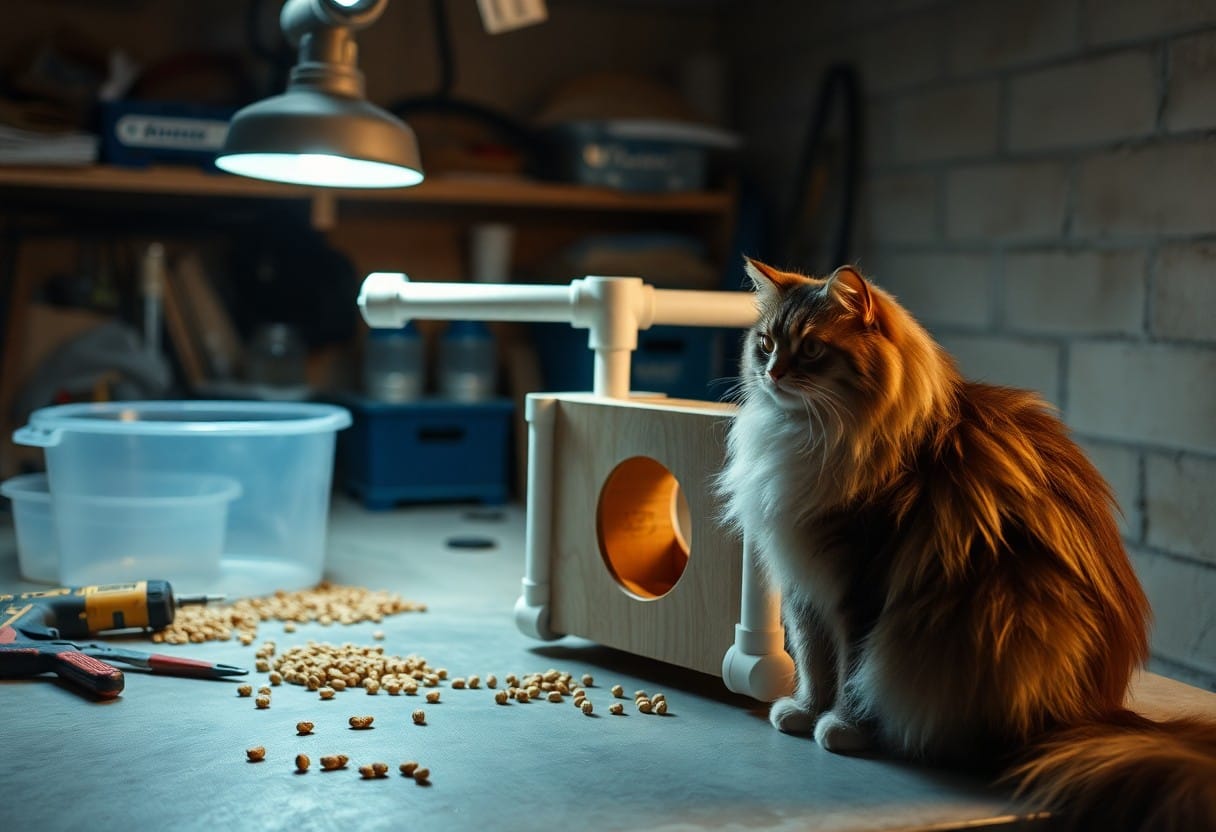
Measure spacing for your kibble size and cut stacked tubes or boxes so treats move but don’t fall freely; you should add adjustable baffles to tune difficulty and secure to a wall or heavy base to stop tipping. Test with small treats, sand smooth interiors, and fasten every joint-avoid loose screws or small parts that could cause choking; this design controls feeding speed and increases mental challenge.
Expert Tips for Successful Implementation
Practice increasing puzzle difficulty slowly so you and your cat adapt to DIY Foraging Toys while keeping kibble portions consistent. Any toys with loose parts can be dangerous, so you must inspect items before use.
- Begin with simple puzzles and short sessions for your cat.
- Check materials for choking hazards and sharp edges.
- Rotate treats and kibble to sustain interest.
Transitioning from bowls to interactive feeders
Shift one meal at a time to an interactive feeder, watch your cat’s body language, and keep sessions brief so you don’t frustrate them while rewarding kibble with foraging play.
Keeping your cat motivated with food variety
Vary textures and flavors-mix dry kibble with occasional wet or freeze-dried toppers to keep novelty high and boost engagement with DIY Foraging Toys.
Rotate flavors daily or weekly, introduce new toppers in small amounts to test tolerance, and avoid feeding toxic foods like onions, garlic, grapes; monitor calories so you don’t overfeed, and use high-value wet meals sparingly to sustain long-term interest.
Safety and Maintenance Protocols
Keep your DIY foragers safe by inspecting materials, avoiding small parts, and storing them out of reach when not supervised; replace anything with sharp edges or loose pieces to prevent choking or cuts.
Routine cleaning and hygiene practices
After each use, wash toys that contact kibble in warm, soapy water, rinse thoroughly, and air-dry; sanitize fabric pieces weekly to avoid bacterial buildup.
Inspecting for structural wear and tear
Inspect seams, glue points, and moving parts weekly; cut away frayed fabric and retire toys with loose components to prevent ingestion.
If you find small tears or exposed stuffing, separate the toy immediately and assess repair options; stitch or use a food-safe adhesive for minor fixes, but discard toys showing persistent fabric decay, exposed staples, or choking hazards. Keep a replacement stock so you can rotate toys while you repair or replace unsafe items.
Final Words
Considering all points, you can safely create varied DIY foraging toys that slow feeding, stimulate hunting instincts, and prevent boredom; test materials for safety, monitor play, and adjust difficulty to match your cat’s skills so you maintain healthy eating habits and mental stimulation without extra expense.
FAQ
Q: How do I make a simple, safe DIY foraging toy to make my cat work for their kibble?
A: Start with a basic toilet-paper-roll puzzle: gather empty cardboard tubes, a shoebox or shallow container, scissors and non-toxic tape. Cut small holes in the sides of a few tubes or leave the ends open, place one or two pieces of kibble inside each tube, then loosely close the ends so the kibble only falls out when the tube is batted. Arrange the tubes inside the shoebox so they can roll and shift when touched. Supervise the first few sessions to check that tape or loose cardboard does not come off and create a swallowing hazard. Washable options include using a low-impact plastic bottle with holes punched for kibble release or a muffin tin covered with tennis balls where food sits under removable balls; these alternatives offer different textures and levels of effort.
Q: How can I adjust foraging toys for kittens, seniors, overweight cats, or very active hunters?
A: Match toy complexity to your cat’s mobility and interest: use very easy open access puzzles for kittens and seniors, moderate resistance puzzles for typical adults, and more challenging sealed or weighted puzzles for highly active hunters. Reduce portion size per dispense for overweight cats and distribute the cat’s daily kibble across multiple short foraging sessions to slow intake. Increase trial frequency rather than portion size so the cat gets mental stimulation without exceeding calorie needs. Change toy height and surface friction for cats with mobility limits, and swap to softer materials or shallower openings if teeth or jaw strength is reduced.
Q: What safety, cleaning and troubleshooting tips should I follow when using DIY foraging toys?
A: Inspect toys before each use and discard or repair any item with loose glue, small detachable parts, sharp edges, or chewed plastic that could be swallowed. Clean washable toys regularly with mild soap and water and allow full drying to prevent mold; cardboard options should be replaced when soiled. Monitor your cat for frustration or disinterest; reduce difficulty or demonstrate how the toy works by releasing a few pieces of kibble onto the floor so the cat learns the payoff. Track weight and meal portions so foraging does not add excess calories to your cat’s diet, and stop use immediately if the cat shows signs of dental pain or difficulty manipulating the toy.