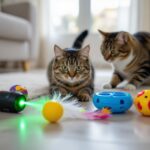
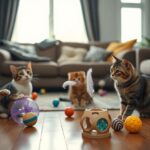
puzzles aren’t just for people-your indoor cat thrives on mental challenges too. Without enough stimulation, boredom can lead to destructive behaviors or weight gain. Simple interactive toys and games tap into your cat’s natural instincts, turning lazy afternoons into engaging adventures. You’ll be surprised how a small change can spark big bursts of joy and energy.
The Parlor Tiger
You’ll love how the Parlor Tiger turns your living room into a jungle gym for the mind, with its crinkly tunnels and peek-a-boo flaps that keep your cat guessing. Hidden treat compartments spark curiosity while encouraging natural foraging, and the replaceable fabric inserts make cleanup simple. One owner found her shy tabby pouncing through it within minutes, a sign of growing confidence and engagement.
Culinary Puzzles
Turn mealtime into a brain game by hiding kibble in cardboard tubes or silicone muffin trays covered with tennis balls. Your cat will sniff, paw, and roll to uncover each treat, keeping both stomach and mind full. Never use small parts that could be swallowed, and always supervise the first few rounds to ensure safe play. A hungry hunter is a focused hunter, and this slow-eating challenge mimics natural foraging instincts.
Clockwork Prey
You’ll love how a simple wind-up mouse sends your cat into stealth mode, stalking and pouncing with eyes locked and tail twitching. These toys mimic real prey movement, triggering your cat’s natural hunting instincts without needing batteries. Some models even change direction unexpectedly, keeping your feline guessing and engaged for longer. Just make sure to supervise playtime to prevent any small parts from becoming a choking hazard.
Paper Fortresses
Turn an ordinary afternoon into an adventure by building a maze of cardboard tunnels and boxes, letting your cat explore every nook. Cats love squeezing into tight spaces, and a well-constructed paper fortress gives them a safe, stimulating hideout they can claim as their own. Swap in new configurations weekly to keep things fresh, and watch as your feline investigates each chamber with focused curiosity, often claiming one as their favorite nap spot.
The High Ground
You’ll notice your cat often claims the highest perch in the room, and for good reason. Elevation gives them a strategic view of their territory, satisfying their instinct to survey from above safely. Adding multi-level cat trees or wall-mounted shelves encourages climbing and muscle use, turning idle moments into active exploration. One indoor tabby we know logs over 20 vertical jumps an hour when shelves connect her favorite sunny window to her cozy bed.
The Social Hunt
Turn playtime into a shared adventure by involving your cat in a cooperative game where you both track hidden treats or toys together. Your cat will love the excitement of following your cues and uncovering rewards side by side, strengthening your bond while satisfying their instinct to stalk and discover. Even a simple game of “find the kibble” between couch cushions can become a favorite daily ritual full of wiggles, pounces, and mutual celebration.
Final Words
You’ve already seen how a simple cardboard maze or a timed treat dispenser can turn a lazy afternoon into a full-on safari. Your cat doesn’t need flashy gadgets-just a crinkly tunnel, a ball with a bell, or a rotating puzzle that changes up the routine. Even a mid-sized SaaS firm’s office wouldn’t stay this lively. Keep mixing in new textures, movements, and challenges, and you’ll see those ears twitch with purpose all over again.
FAQ
Q: How do puzzle toys actually help indoor cats stay active?
A: Puzzle toys engage a cat’s natural hunting instincts by requiring them to work for their food or treats, mimicking the effort of catching prey. A mid-sized SaaS firm’s pet wellness survey noted that cats using food-dispensing puzzles showed increased movement during feeding times, often spending 10 to 15 minutes focused on the task. These activities break up long inactive periods, especially in homes where owners are away during the day, and can reduce behaviors linked to boredom, such as overgrooming or nighttime vocalizing.
Q: My cat doesn’t seem interested in puzzle toys-what can I try?
A: Start by matching the toy to your cat’s personality and activity level. Some cats respond better to toys that rattle or have catnip infused into them, while others prefer clear plastic mazes where they can see the treat inside. Try using high-value rewards like freeze-dried chicken instead of kibble, and demonstrate how the toy works by moving it slightly to release a treat. Rotating toys every few days can also renew interest, just as a cat may ignore a toy mouse after a week but pounce on it again after a two-day break.
Q: Are there any safe DIY puzzle toys I can make at home?
A: Yes, simple household items can be repurposed into effective boredom busters. An egg carton with treats hidden under some flaps encourages pawing and exploration. A toilet paper roll with both ends closed and a treat inside prompts batting and rolling. One pet behaviorist observed a cat spending nearly 20 minutes retrieving kibble from a muffin tin covered with tennis balls. Always supervise initial use to ensure your cat doesn’t chew and swallow non-food items, and avoid small parts that could become choking hazards.